The One Skill No AI Tool Will Ever Replace
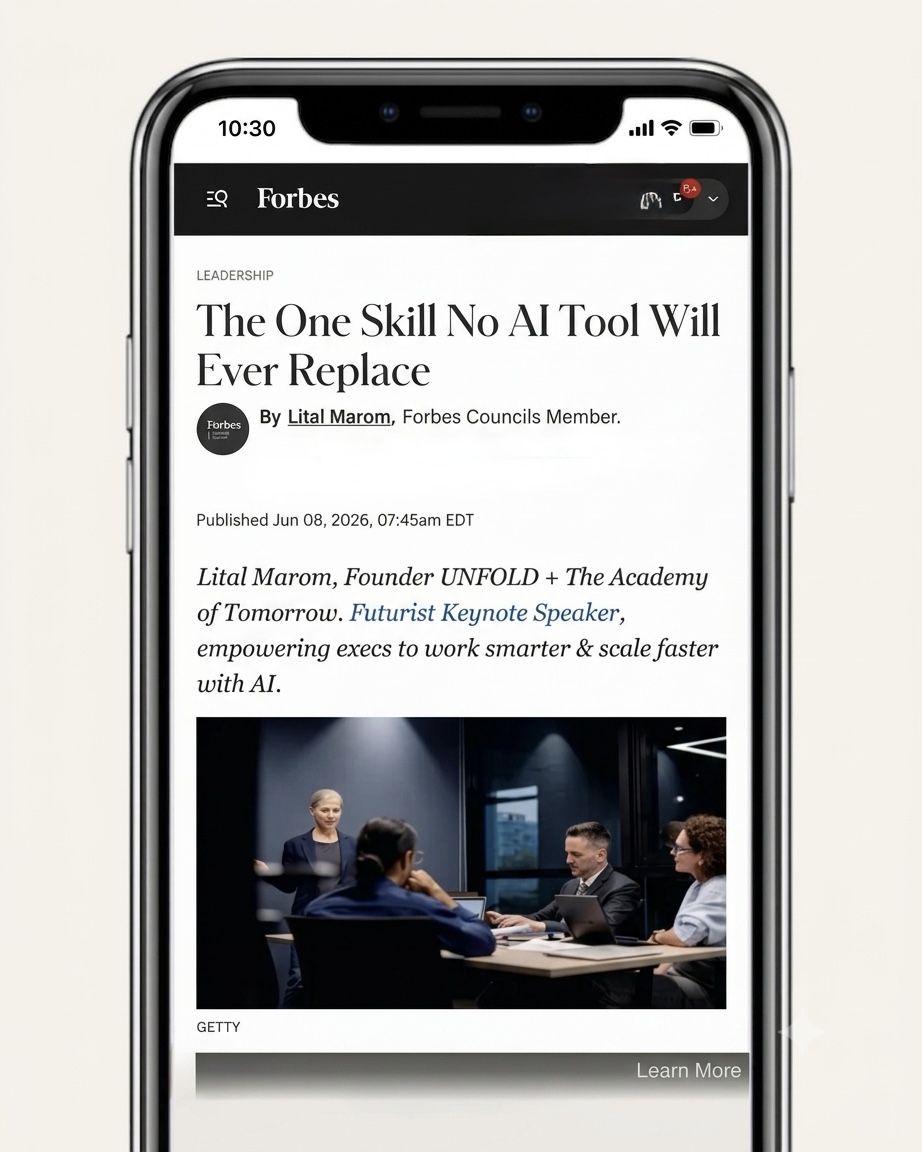
This article was originally published in Forbes and is republished here for my community.
A few weeks ago, I sat in on a strategy session with the executive team of a global insurance firm. The CEO opened with a sharp question about a market entry decision. Before anyone could form a thought, four laptops opened. Four prompts went into four chatbots. The room then debated which AI gave the best response.
No one debated the decision itself.
That moment stayed with me because it crystallized something I have been watching unfold across boardrooms for the last 18 months. Leaders are getting faster. Their teams are producing more. The dashboards look healthier than ever. And underneath all of it, something quiet is happening that almost no one is naming.
Judgment is atrophying.
What AI Actually Does, And What It Cannot Do
To understand what is at stake, leaders need to be precise about how this technology works. A large language model is, at its core, a statistical engine. It takes the data it has been trained on and predicts the next most likely word. It is extraordinarily good at this. It is not, however, doing what humans do when we think.
There are skills that cannot be translated into data. Taste. Trust. Discernment. The texture of a relationship built over 15 years. The instinct that something in a deal feels wrong even when every metric says yes. These cannot be captured in a training set, which means they cannot be replicated by any model. They live inside the people who developed them through years of being right, being wrong and learning the difference.
This is the human edge. And it is the one thing that gets quieter every time a leader takes an AI output and pastes it into a decision without examining it.
The Source Of Input Versus The Source Of Truth
Here is the reframe I offer every leadership team I advise. AI is not a source of truth. It is a source of input. The distinction sounds small. It is not.
When you treat AI as a source of truth, you stop thinking. You receive the output, you act on it and you assume the work is done. When you treat AI as a source of input, you stay in the seat that matters. You read the output. You ask whether it makes sense. You check for hallucinations. You decide.
The decision is the work. The decision has always been the work. Tools change. Decisions do not.
You Can Outsource Tasks; You Cannot Outsource Judgment
Most leaders I work with understand this in theory. In practice, the data tells a different story. Calendar audits show that the time AI has freed up is not being reinvested in deeper thinking. It is being absorbed by more meetings, more emails, more shallow throughput. The promise was that AI would handle the repetitive work so leaders could do the strategic work. The reality is that many leaders are quietly handing the strategic work to AI, too.
That is the trade that breaks careers in the next five years.
You can outsource a draft. You can outsource a first-pass analysis. You can outsource a market scan, a meeting summary, a code review, a competitive teardown. What you cannot outsource is the act of looking at what came back and deciding whether it is right. That act is judgment. It is the one capability that compounds with experience and the one that disappears the moment you stop practicing it.
Judgment Works Like A Muscle
The science here is unambiguous. Cognitive skills, like physical ones, follow a use-it-or-lose-it pattern. Neural pathways that fire repeatedly grow stronger. Pathways that go unused get pruned. The brain is ruthlessly efficient. It will not maintain a capacity you no longer demonstrate you need.
This is why the leaders I worry about most are not the ones who refuse to use AI. Those leaders will get left behind, and they know it. The leaders I worry about are the ones who use AI for everything, accept every output and feel more productive than ever. They are running a quiet experiment on their own cognition, and the results will not show up for another two or three years. By then, the muscle will be smaller. The instinct will be slower. And the work that once felt obvious will feel foreign.
Four Questions To Protect Your Edge
For senior leaders trying to use AI without losing themselves to it, these are the questions worth asking weekly. Not annually. Weekly.
1. "Where am I accepting AI output without examining it?" Be honest. The places where you have stopped reading carefully are the places where your judgment is going first.
2. "What are the decisions only I can make?" Name them. Protect them. These are the ones AI should never touch as a source of truth, only as a source of input.
3. "When AI gives me an answer, what is the first question I ask?" If your default is to use it, your judgment is atrophying. If your default is to challenge it, your judgment is sharpening.
4. "Am I using the time AI saved to think more or to do more?" The answer separates the leaders who will define the next decade from the ones who will be quietly defined by it.
The Defining Skill Of The Next Era
We are at a moment where every leader has access to the same tools. The same models. The same prompt libraries. The same productivity gains. The competitive edge is no longer in the technology. It is in what you do with what the technology gives you.
The leaders who will architect the next era are the ones who treat judgment as their most strategic asset. Not their team. Not their tools. Not their data. Their judgment, sharpened daily through the discipline of questioning every output, examining every recommendation and refusing to confuse speed with thinking.
Don’t outsource your judgment. It is the one thing you have that no tool will ever replace.
Protect your edge.
About Lital Marom
Lital Marom is a keynote speaker, AI visionary, and strategic advisor who empowers executives to work smarter and scale faster with AI. An engineer-turned-entrepreneur who has lived in 10 countries and founded four companies, she helps leaders turn disruption into growth and build future-ready organizations that scale and lead. A Forbes Coaches Council contributor since 2018, she advises Fortune 50 leaders on AI, innovation, leadership, and business transformation.
Explore Lital's AI keynote topics.